The Lock Before the Key: Google Hands Its Newest Model to the Defenders First

A new product usually gets the same treatment. A company finishes its most ambitious work, picks a date, invites the press, and opens the doors to everyone at once. On Wednesday, Google skipped the ceremony. It announced Gemini 4 Argon, which it describes as the most capable model it has built, and then gave it first to a vetted circle of people whose job is to stop strangers from breaking into other people’s systems.
The decision is the story. A company that holds back its best work, when its rivals have spent months taking the headlines, is telling you something about what it thinks the work can do.
A launch with a gate on it
Google announced Argon on September 30. It is the first model of the Gemini 4 generation, and it arrives after a stretch in which the company shelved a planned Gemini 3.5 Pro to concentrate on the next generation, and after OpenAI and Anthropic had pulled ahead with their own latest releases. For Google, Argon is a bid to get back into the front rank.
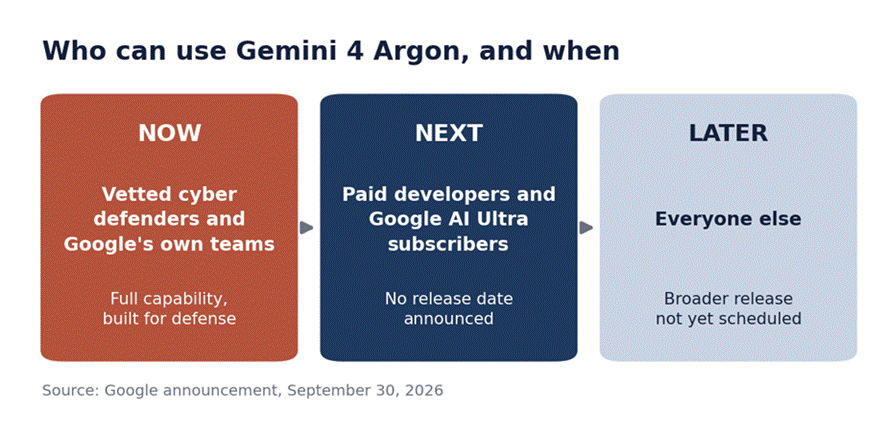
But anyone hoping to try it will have to wait. For now it is available only to members of a program called Fairwind and to Google’s own engineers. Developers, businesses and ordinary users are not on the list. Paid developers and subscribers to Google AI Ultra, the company’s premium plan, are next in the queue. Google has not said when, only that it will happen as soon as possible.
What Fairwind actually is
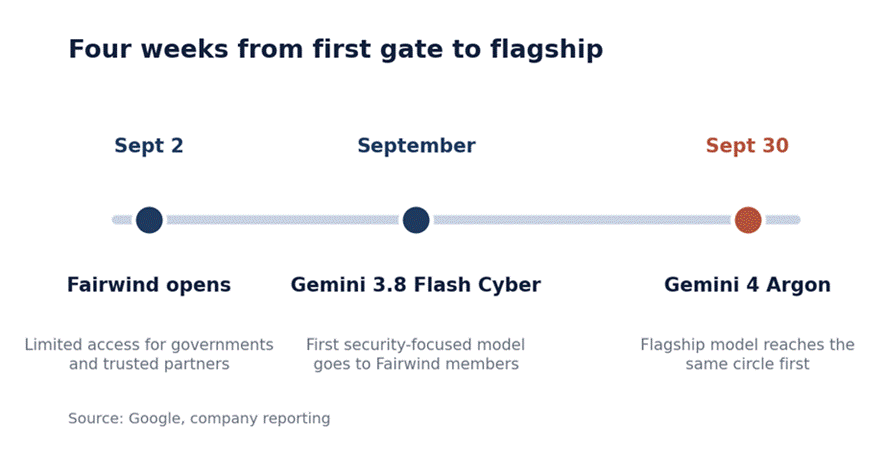
Fairwind is barely a month old. Google opened it on September 2 as a limited-access program for governments and trusted partners who need the company’s most advanced security tools, and says more than 650 partners have joined worldwide. Its first offering paired a security-focused model, Gemini 3.8 Flash Cyber, with a Google system called CodeMender that can find a weakness in software, confirm it is real, and prepare a fix. One industry report lists governments, healthcare providers, telecom companies and security vendors among the early members.
The twist is in how Argon reaches them. Those defenders, along with Google’s internal security teams, receive the model without the built-in restrictions that the public version will carry. That sounds alarming until you consider the alternative. A locksmith cannot test a lock-picking tool with the safety catch on.
Google’s stated reasoning is a matter of timing. The company wants defenders to have a window in which they can strengthen their systems before anyone with worse intentions has access to something comparable. A model that can discover and patch serious flaws is, by the same ability, a model that could be pointed at them. Staging the release is Google’s way of letting the people who fix things move first.
What it is built to do
Argon is designed for long jobs with many steps, the kind a senior engineer or an associate at a law firm might work on for days. Google lists real-world software engineering, enterprise work such as legal and finance, and cyber defense as its main targets. It can also read charts and follow the contents of long videos.
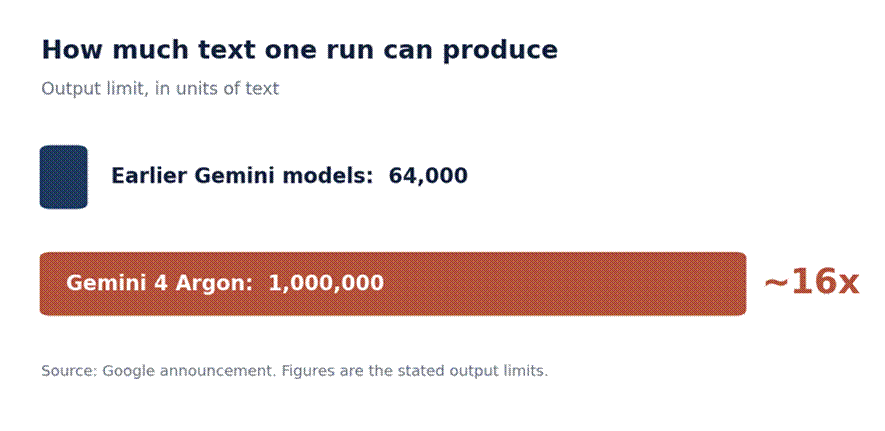
The most striking change is one of capacity. A single run can now produce up to one million units of text, against 64,000 for earlier Gemini models. That is roughly sixteen times more room, and it changes the kind of task the model can finish in one sitting. The difference is the one between answering a question and delivering a project.
Google backs the claim with numbers of its own. It reports a score of 77.9 percent on a test of long software-engineering tasks, and one account says Argon leads on 12 of the 18 tests the company chose to disclose. The usual caution applies: these are results the company selected and published itself, and independent verification is still to come.
The more persuasive evidence is what Google’s own staff have done with it. Engineers have used Argon for debugging and for large migrations of old code. In one case, groups of Argon programs studied readings from Google’s data centers and found memory savings of more than 300 tebibytes after the changes went live. A tebibyte is roughly a thousand gigabytes. Its quantum computing researchers have also used the model to refine algorithms.
The safeguards, and who tests them
The public version will carry restrictions. Google says it is designed to refuse harmful security requests, as well as requests involving chemical, biological, radiological and nuclear weapons, while still helping with legitimate research that could be used either way. Teams employed to attack the model, some inside Google and some outside it, have tested those defenses.
Two further measures operate while the model works. Separate monitors watch its reasoning and its actions and can halt a task when something looks wrong. Google also says Argon is better than its predecessors at resisting hidden instructions planted in the documents and web pages it reads, a weakness that security researchers have been warning about for some time.
None of this settles the underlying tension. The tool that helps a hospital find a flaw in its network is the same tool that could help a criminal find one. Google’s answer is to start with the hospital and to learn from what happens. It is a reasonable answer, and it will be judged by what the first few months show.
The price, and the doubts
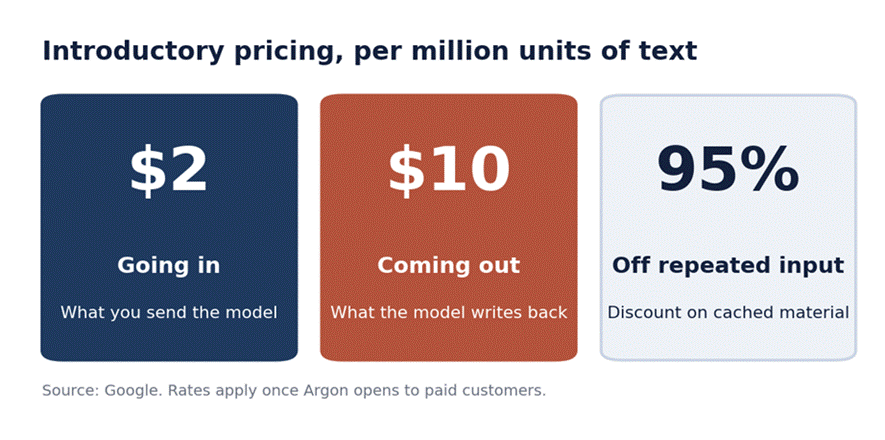
Google is also competing on cost. When Argon opens to paying customers, the introductory rates will be $2 per million units of text sent in and $10 per million written back, with a 95 percent discount on material the model has already seen. Those are aggressive numbers for a model in this class.
Doubts have followed the announcement. Bloomberg reported that some Google employees question how well the model performs on real coding work, even though its test scores are strong. Google disputes that account and says staff across the company have used versions of Gemini 4 for weeks, some with unlimited access. Both things can be true at once. A test measures what it was built to measure, and a working engineer measures something else.
The race the public is watching
There is also a larger question than any scoreboard. Much of the attention in the industry has moved from what a model can do to what an assistant can do for an individual, handling errands, bills and bookings on a person’s behalf. Meta’s free assistant, Muse, has been gaining ground. Google’s equivalent, called Spark, remains behind a paywall. Google’s head of Gemini product told CNBC that the company is still deciding whether Argon should power the more demanding work inside Spark.
That is the quiet tension in this launch. Argon is a strong card, but it may be the right card for a different game than the one most customers are playing. A model aimed at software engineers and security teams does not, on its own, win over someone who wants an assistant to chase a refund.
What to watch
The next few weeks will matter more than the announcement did. Google needs to say when Argon will reach paying customers, and to show that the restrictions on the public version hold up against people who spend their days trying to get around them. Independent testers will also get a chance to check the company’s numbers.
If the gamble works, the defenders will have found and closed a good many holes before anyone else gets the tool, and Google will have shown that a company can hold back its best work without losing the race. If it does not, the delay will look like caution that bought very little. Either way, Argon is a test of a simple idea: that the lock should be fitted before the key is handed out.
\ Get the latest news /