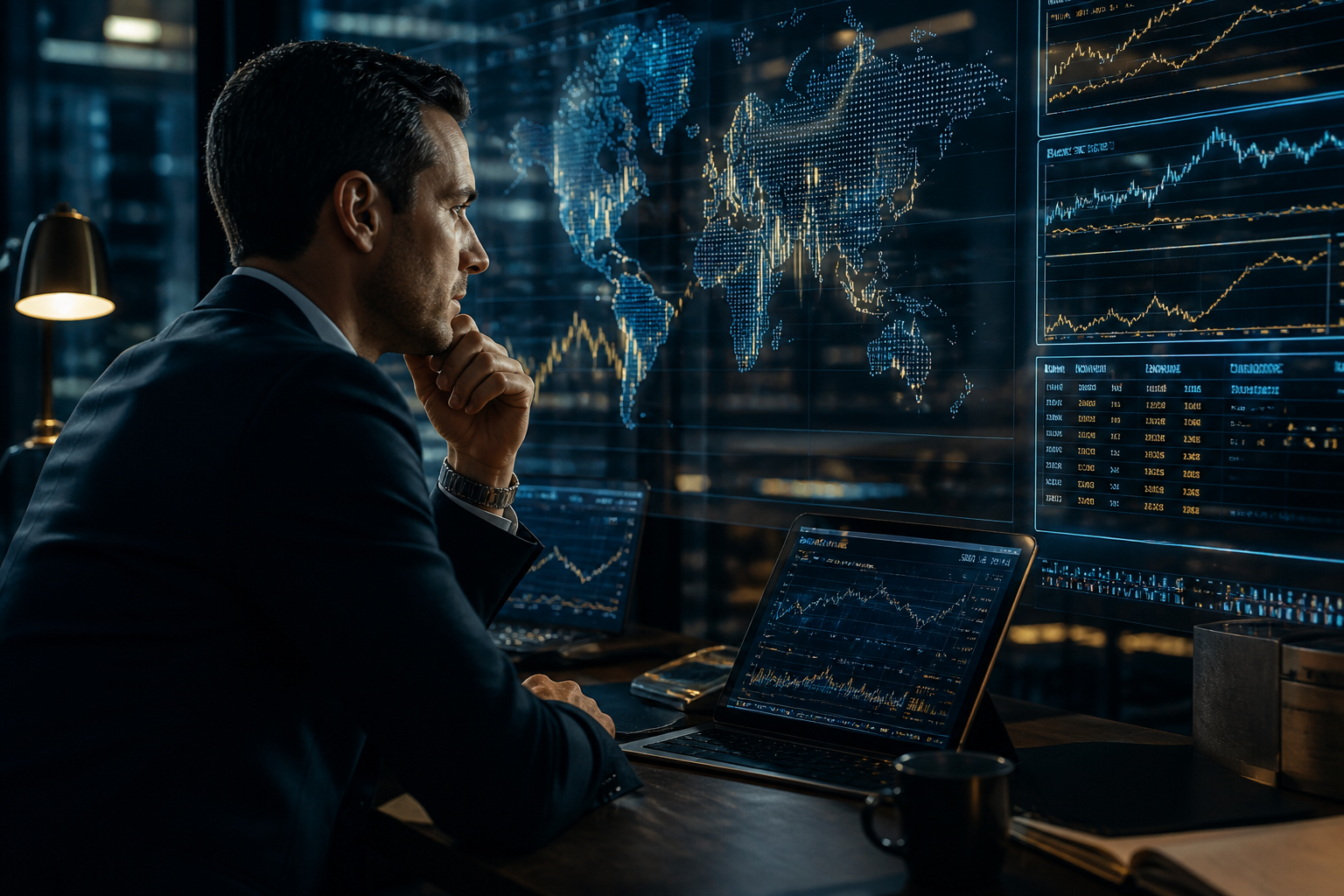
The biggest change in financial careers may not be that machines replace people. It may be that the people who know how to work with machines replace the people who do not.
The real question is not whether AI will replace financial workers
Artificial intelligence is already changing the financial workplace, but the transformation is more nuanced than the popular image of a robot taking over a trading desk. In most cases, AI does not remove an entire profession overnight. It automates selected tasks, accelerates research, detects patterns in vast datasets, and changes what employers expect from the people who remain.
That distinction matters in foreign exchange, gold, and equities. These markets are too complex, too political, and too dependent on human judgment for a single model to eliminate every role. Yet many traditional activities, such as manually collecting data, screening securities, summarizing news, preparing routine reports, and monitoring repetitive price conditions, are increasingly well suited to software.
The result is a shift from task replacement to job redesign. A trader may spend less time searching for information and more time judging whether a signal is credible. A research analyst may write fewer first-draft summaries and spend more time challenging assumptions. A risk manager may monitor thousands of scenarios instead of reviewing a small sample. Human expertise does not disappear, but its center of gravity moves upward.
The World Economic Forum’s Future of Jobs Report 2025 reflects this broader pattern. It identifies AI and information-processing technologies as a major driver of business transformation through 2030, while also highlighting creative thinking, resilience, flexibility, and lifelong learning as increasingly important human capabilities.
Where AI is most powerful in financial work
AI performs best when the work involves large volumes of structured or semi-structured information, repetitive comparisons, fast classification, and continuous monitoring. In markets, that includes:
Cleaning and organizing price, volume, macroeconomic, and alternative datasets.
Detecting unusual movements, correlations, and changes in market behavior.
Summarizing earnings releases, central-bank statements, economic data, and geopolitical news.
Generating scenario analysis and stress tests for different market conditions.
Monitoring portfolios for concentration, volatility, liquidity, and risk-limit breaches.
Supporting trade execution, order routing, and compliance surveillance.
These capabilities create leverage. A small team can investigate more instruments, test more hypotheses, and respond to new information faster. But leverage is not the same as certainty. A model can process data efficiently and still produce a confident answer based on incomplete, biased, stale, or misunderstood information.
That is why the strongest financial organizations treat AI as a decision-support layer, not an oracle.
Forex trading: from chart-watching to machine-assisted decision-making
Foreign exchange is a natural environment for AI because it operates continuously across global time zones and reacts to a wide range of inputs: interest-rate expectations, inflation, employment data, trade flows, political developments, commodity prices, and changes in risk appetite.
In a traditional workflow, a currency trader might monitor economic calendars, read central-bank communications, compare technical indicators, and track market sentiment across multiple screens. AI can compress much of this process. Natural-language systems can classify the tone of policy statements, extract changes in forward guidance, and compare a new speech with years of previous communications. Machine-learning models can identify combinations of variables that preceded similar episodes in the past.
This changes the role of the human trader in three important ways.
1. Faster preparation
AI can prepare a structured pre-market brief: the most important scheduled events, the currencies most exposed to them, unusual positioning, and scenarios that could produce volatility. The trader begins with a map of the market rather than a blank screen.
2. Better monitoring
Models can watch many currency pairs at once and alert the team when volatility, liquidity, spreads, or cross-asset relationships move outside normal ranges. This is especially useful during news events, when speed and attention are limited.
3. More disciplined execution
AI-assisted systems can enforce predefined rules for position sizing, stop-loss distances, exposure limits, and trade timing. This may reduce some forms of emotional trading, although it cannot eliminate poor assumptions or reckless risk-taking.
The danger is overconfidence. Foreign-exchange relationships can change when a central bank changes its reaction function, when a geopolitical shock breaks historical patterns, or when many market participants respond to the same signal. A backtest can look impressive and still fail in live conditions because of transaction costs, slippage, changing liquidity, or data leakage.
The future forex professional will therefore need two skill sets at once: the ability to work with models and the judgment to recognize when a model’s environment has changed.
Gold trading: combining macro context with real-time intelligence
Gold is often described as a safe-haven asset, but its price is influenced by a complicated mixture of real interest rates, inflation expectations, currency movements, central-bank purchases, geopolitical uncertainty, investor positioning, and broader market stress.
AI can help analysts connect these variables more quickly. It can track changes in bond yields and the U.S. dollar, monitor official statements, compare regional demand signals, and identify shifts in investor sentiment. It can also organize information that is difficult to process manually, such as shipping data, commodity reports, news coverage, and large collections of historical market observations.
For a gold analyst, the value is not simply a prediction that the price will rise or fall. The larger benefit is a more complete explanation of what may be driving the market and which variables deserve attention. A human expert can then ask the questions that matter:
Is the move driven by a durable change in real yields or by a temporary flight to safety?
Is demand broad-based, or is it concentrated in a small group of participants?
Does the current pattern resemble a historical regime, or is the market behaving differently?
What would invalidate the thesis?
Gold also illustrates why context remains essential. A model trained on one decade may misread another decade because monetary policy, market structure, and geopolitical conditions have changed. AI can organize evidence, but it cannot guarantee that the past is a reliable template for the future.
Stock markets: research becomes faster, but not automatically better
Equity research may experience one of the most visible changes because the work contains many information-heavy tasks. AI can screen thousands of companies, compare financial statements, identify changes in management language, summarize conference calls, and generate questions for deeper investigation.
This will likely reduce the value of purely mechanical research. A report that only repeats public information, calculates standard ratios, and offers a generic conclusion can increasingly be produced by software. The analyst’s advantage must move toward interpretation, primary research, industry knowledge, and the ability to test whether a company’s story matches its economics.
AI can support stock selection in several ways:
Idea generation: finding companies with unusual earnings trends, improving margins, changing guidance, or emerging operational signals.
Fundamental analysis: extracting and comparing revenue, cash flow, leverage, capital expenditure, and segment data.
Sentiment analysis: evaluating language in filings, news, transcripts, and public communications.
Portfolio construction: estimating factor exposures, correlations, drawdowns, and concentration risks.
Ongoing surveillance: flagging changes that may require an analyst to revisit an investment thesis.
But the final investment judgment still requires accountability. A model may identify a statistical relationship without understanding a company’s competitive position, regulatory exposure, accounting quality, or management incentives. It may also favor businesses that resemble the data used in training while missing a genuinely new situation.
The best equity teams will use AI to expand the number of questions they can investigate, not to avoid asking difficult questions.
Which financial jobs are most likely to change?
The jobs most exposed to automation are those dominated by predictable, repeatable, information-processing tasks. Entry-level research, routine market reporting, basic data preparation, first-pass compliance reviews, and standardized portfolio monitoring may all be redesigned.
That does not mean every entry-level position disappears. It means the learning path may change. Young professionals may have fewer opportunities to spend years performing manual tasks before moving into higher-value work. Firms will need to create new training systems so early-career employees learn market structure, risk, communication, and model evaluation rather than simply learning how to collect information.
Roles likely to grow include AI and machine-learning specialists, quantitative researchers, model-risk professionals, data engineers, cybersecurity experts, financial technologists, and analysts who can connect domain knowledge with technical tools. Human capabilities will also become more valuable: clear communication, skepticism, ethical judgment, negotiation, creativity, and the ability to explain uncertainty to clients and decision-makers.
The IMF has estimated that a large share of global employment is exposed to AI, with advanced economies more exposed because they contain more cognitive-intensive roles. Exposure, however, is not the same as destruction. Some tasks are substitutes for human labor, while others are complements that allow people to become more productive.
The risks: faster mistakes, crowded trades, and invisible dependency
AI can improve financial work, but it can also make failure faster and more widespread.
First, models can hallucinate, misread data, or produce plausible explanations that are simply wrong. In a financial setting, a small error can create a large loss if it influences a trade, a client communication, or a risk decision.
Second, many institutions may adopt similar datasets, models, and signals. If those systems react in the same direction, markets can become more crowded and correlated. The Financial Stability Board and the Bank for International Settlements have both highlighted concerns about common models, concentration among technology providers, cyber risk, limited explainability, and the possibility that automation may amplify stress.
Third, AI can encourage a false sense of objectivity. A numerical output may look neutral even when the data reflects human choices, historical bias, missing information, or an unsuitable objective function.
Finally, technology creates dependency. A firm that cannot explain its model, validate its data, or operate during a vendor outage has not built resilience. It has simply outsourced judgment.
The winning model: human expertise with machine leverage
The future of financial work will not be defined by humans versus machines. It will be defined by workflows that combine machine speed with human accountability.
A responsible AI-enabled trading or investment process should include:
A clear purpose: the model should solve a defined problem, not generate impressive-looking outputs.
Reliable data controls: inputs must be tested for quality, timeliness, completeness, and bias.
Out-of-sample validation: performance must be tested on data the model did not see during development.
Human review: material decisions should have an accountable person who can challenge the output.
Risk limits: position sizing, leverage, liquidity, and loss controls should not depend on a model’s confidence alone.
Auditability: the organization should retain records of data, model versions, decisions, overrides, and incidents.
Fallback procedures: teams must know how to operate when systems fail or market conditions become abnormal.
For professionals, the practical lesson is straightforward: learn how the market works, then learn how AI changes the way information moves through it. The most valuable worker will not be the person who blindly follows a model or the person who refuses to use one. It will be the person who can interrogate the model, understand its limits, and make a better decision because of it.
Conclusion: careers will be redesigned before they are eliminated
Artificial intelligence is likely to remove some tasks, reshape many jobs, and create new specialties across forex, gold, and stock markets. It will reward speed, but speed without judgment is dangerous. It will reward technical fluency, but technology without market understanding is fragile.
The defining advantage of the next generation of financial professionals will be a hybrid capability: quantitative enough to use AI, skeptical enough to test it, and human enough to take responsibility when the future refuses to behave like the past.
AI will not make markets simple. It will make the difference between disciplined and undisciplined decision-making more visible.
Important note: This article is for educational purposes only. AI tools and market analysis cannot eliminate investment risk, and nothing here should be treated as financial advice or a guarantee of future performance.