The World’s First Processor Made of Living Brain Cells
Inside DishBrain, the Melbourne experiment that taught a dish of human and mouse neurons to play Pong — and the commercial biological computer it grew into.
In a lab in Melbourne, roughly 800,000 neurons are living on a silicon chip, wired into a video game they were never born to play. Within minutes, they learn to move a paddle and return a ball — not because anyone programmed them to, but because a feedback loop taught them it was worth trying. The system is called DishBrain, and it may be the closest thing yet to a computer that thinks with the same material a brain does.
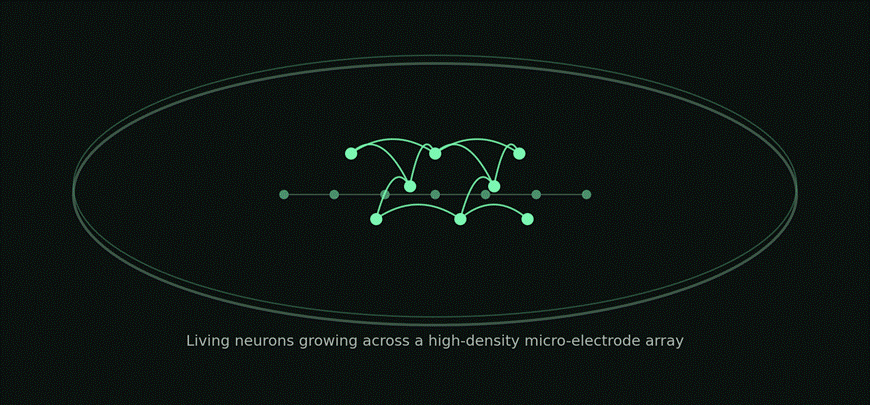
Living neurons growing across a high-density micro-electrode array (illustration).
A dish that reads and writes to neurons
DishBrain was built by Cortical Labs, a Melbourne-based biotech startup, in collaboration with researchers from Monash University, RMIT, University College London, and the Canadian Institute for Advanced Research. The team, led by chief scientific officer Dr. Brett Kagan, cultured cortical neurons — some taken from mouse embryos, others grown from reprogrammed human stem cells — directly onto a high-density micro-electrode array.
That array does two things at once: it records the tiny electrical spikes neurons naturally produce, and it can deliver electrical pulses back to them. Once the cells settle onto the chip, they begin forming connections with each other, the way neurons do inside a living brain. The result is a small, self-organizing network that the researchers can both listen to and talk to.
“We’ve shown we can interact with living biological neurons in such a way that compels them to modify their activity — leading to something that resembles intelligence.” — Dr. Brett Kagan, Cortical Labs
Teaching a dish to play Pong
To test whether the network could actually learn, the team connected it to a computer running a simplified version of Pong, the 1970s paddle-and-ball game. Electrodes on one side of the array signaled the ball’s position; the neurons’ activity, in turn, moved the paddle. When the paddle hit the ball, the cells received a short, predictable pulse of stimulation. When they missed, they were hit with unpredictable, noisy stimulation instead — an unpleasant signal the network had reason to avoid.
Guided by nothing more than that feedback, the neurons began adjusting their firing patterns to keep the predictable signal coming — in effect, learning to play.
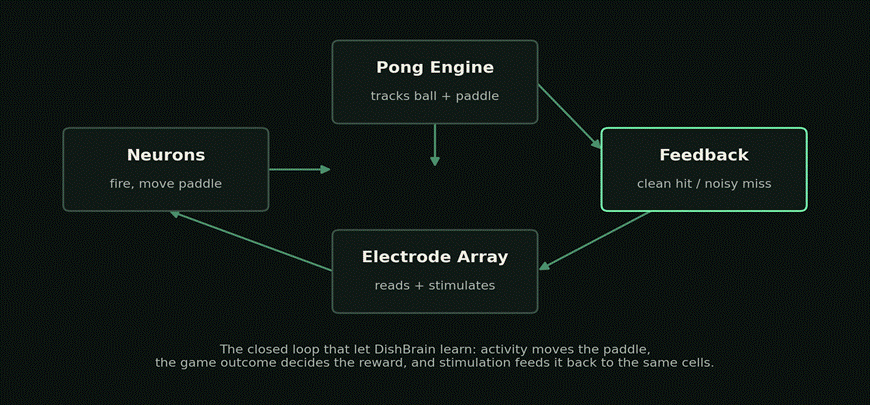
The closed loop that let DishBrain learn (illustration).
The findings, published in the journal Neuron in October 2022, showed the network’s rallies growing longer over time — evidence the researchers described as “synthetic biological intelligence.” Interestingly, the human-derived neurons sustained longer rallies than the mouse-derived ones, though both showed clear signs of adapting their behavior toward a goal.
From petri dish to product
What started as a research demonstration has since become the foundation of a commercial platform. In 2025, Cortical Labs unveiled CL1, described as the first commercial “body in a box” biological computer. It uses lab-grown neurons layered onto a silicon chip and runs on biOS, an operating system that lets developers send code to the living network and read back its computations.
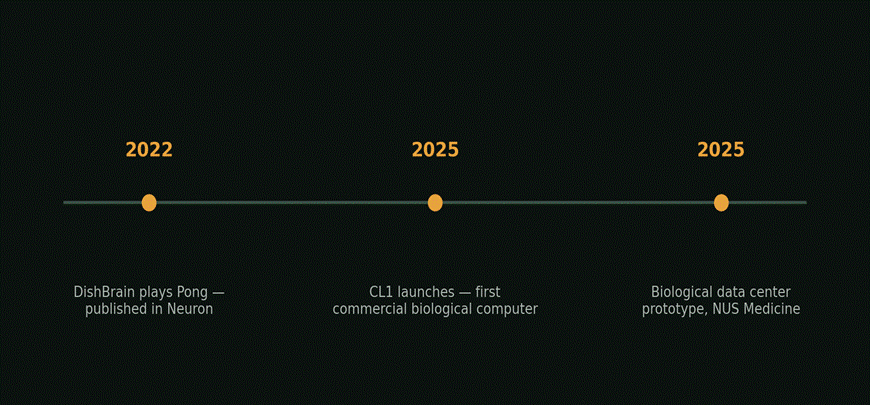
Timeline of the project, from the original study to the commercial platform.
Later that year, Cortical Labs partnered with the National University of Singapore’s medical school to prototype a rack of 20 neuron-based computers, each holding roughly 800,000 lab-grown human neurons, reportedly consuming a fraction of the power of a conventional GPU server.
Why grow a computer instead of building one
The appeal isn’t raw speed — silicon still wins there by a wide margin. It’s efficiency and adaptability. Biological neurons run on a tiny power budget compared with GPU-based systems, and unlike conventional neural networks, they don’t need to be pre-trained on massive, fixed datasets; they adjust in real time, from direct interaction with their environment. Kagan has pointed to this as the deeper motivation: silicon computers are powerful but rigid, while biology learns to generalize in ways today’s AI still struggles to match.
None of that makes the technology mature. The neurons in these systems are living tissue, and living tissue has a lifespan, needs nutrients and waste removal, and is still far from reliably storing memory or handling complex, sustained computation. Researchers are candid that this is early-stage work — closer to a new instrument for studying how intelligence emerges than a replacement for the silicon chip in a laptop.
What it means, so far
DishBrain isn’t a brain in the way science fiction imagines one, and Cortical Labs isn’t claiming it’s conscious. What it has done is show, concretely, that a network of living neurons — given nothing more than a consistent reward and punishment signal — will reorganize its own behavior toward a goal, in minutes, outside of a living body. That single result is why a Pong-playing dish of cells has become a serious research platform, and now the seed of a new class of computer.
\ Get the latest news /